Sunday, January 31, 2016

The Four Sublime States


Between good and pure are the four sublime states as expounded by the Lord Buddha. Abide in the four sublimes states equally. They are your mental wealth to overcome any defilements. Cultivate in these qualities as they serve towards your mental, emotional and physical well being. They help put you in good mental states so that you can instill inner peace & harmony, joy & happiness, calmness & sweetness to experience divine bliss.   

Saturday, January 30, 2016

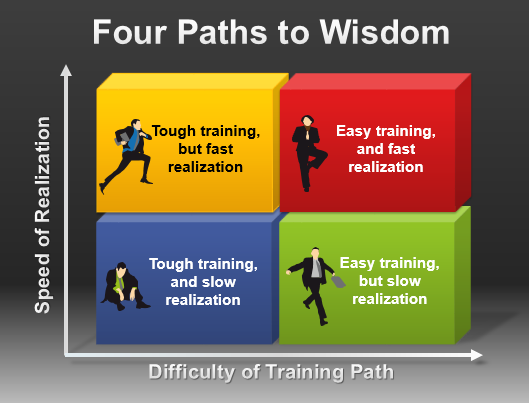
The Four Paths to Wisdom

According to Venerable Kai Zhou, there are four paths to acquiring wisdom. Some people acquire it the easy way and some acquire it through the hard way. I believe that karma and present diligence plays a large part in this.  If one has good karma and is diligent in one's practice, one can achieve a faster realization. The most important thing to have is right view, followed by right effort and right mindfulness to follow-through.

Saturday, May 2, 2015

The Mind is the Boss

The mind gets conditioned by the thoughts we have everyday, so much so that it becomes ingrained as a habit. Hence it is important to cultivate wholesome thoughts and not unwholesome thoughts as they will mould our character. Very few people are aware of the ability of the mind to generate thought forms. These thought forms are energy beings with consciousness. This subject is taught in Theosophy and Pranic Psychotherapy. Thought forms, whether positive or negative, can affect oneself and other people. Therefore, it is important to generate good thoughts to benefit oneself and others. Do not sabotage yourself by thinking negative of oneself, or unintentionally hurt your loved ones with negative thoughts about them. Remember that the mind is the forerunner of all things, for thoughts will lead to feelings & emotions which will have subsequent impact on speech and action. That is generating karma as intention is involved.  

Saturday, April 18, 2015

Six Sense Bases and the Universal Characteristics

This is a good meditation practice that teaches us to be mindful of the workings of our six sense bases. Our six sense bases (eye, ear, nose, tongue, body, mind) allow us to function our physical bodies to respond to external stimuli. Many of us are very fortunate to have a healthy body with proper functioning of our sense bases. However, many of us if not mindful, will be carried away by the sequence of events whenever any of our sense bases are activated by whatever external stimuli in the environment. For example, we see many things (external forms - sight) with our eyes, we can be alert (eye consciousness) but might not register any attention until someone or something catches our eyes, (eye contact) which results in a feeling as a result of the eye contact (which can either be pleasant, unpleasant or neutral). But if we continue to like or dislike what we see, it will lead to craving (desire) or aversion. Now this is suffering because this will eventually lead to dissatisfaction. Therefore to combat this situation, we will need to understand that all things are subject to the three universal characteristics - impermanence, unsatisfactory nature, and non-self (as this body is not you). And because this body is not you, this body is not me, not mine, and not myself.  Then we are able to develop this wisdom not to hold on to anything. and learn to let go,        

Monday, March 30, 2015

The 37 Constituents of Enlightenment

There are seven categories comprising a total of 37 constituents of enlightenment. The 37 constituents are also known as "states pertaining to enlightenment", "factors of enlightenment" or "requisites of enlightenment". They all form the basis of meditative training as expounded by the Buddha. They serve as a kind of road map and should be practiced with vigor and determination by disciples to succeed on the path. According to Venerable Seelananda, the 37 factors are all interconnected. When it is raining, water is everywhere, which is like the river that leads to the ocean. Ultimately, the 37 factors of enlightenment can be grouped into the three aspects of  wisdom, morality and mental development, which is also found in the Noble Eightfold Path.   

Wednesday, March 18, 2015

The Noble Eightfold Path

The noble eightfold path is the fourth noble truth to end dukkha.  The eightfold path is divided into three sections, with each supporting one another. It contains the sections on wisdom (panna), morality (sila), and mental development (samadhi). The journey does not simply end with mental development because only with mental development can one grows his wisdom to gain liberation or enlightenment. Remember that all three supports the other. One cannot hope to only acquire the wisdom and practice morality (for example adhering closely to the five precepts). These two have to be supported by mental development. And the latter involves practising meditation, especially samatha and vipassana. The first one is needed to help calm down and unify your mind, and the second one  is needed to let you "see things as they are". The dharma is not about just gaining book knowledge, but also realising the three universal characteristics of impermanence, unsatisfactory nature, and non-self. 

Sunday, March 15, 2015

The Four Noble Truths

In the mundane world, what is perceived as the truth to one person might not be accepted as the truth by another person. Also, there are different levels of the same truth, according to the mental capacity of different people to see the truth. However, the Four Noble Truths is the ultimate truth as it is well expounded by the Lord Buddha. This means that the four noble truths is complete as it is already, you cannot simply deduct from the four or add another one to the four. The first truth is unsatisfaction which cause dukkha or suffering. Why ?  Because all conditioned things in this universe is changing, and nothing is permanent. So if one holds the wrong view or understanding that things are permanent, then one will get very disappointed with the outcome indeed. Please refer to the diagram above on the other three noble truths.